South Africa’s shift to a circular economy will not happen through theory alone. It will be built by entrepreneurs finding practical answers to problems the country knows well: too much waste, too few jobs, growing pressure on resources and too many people left outside the formal economy.
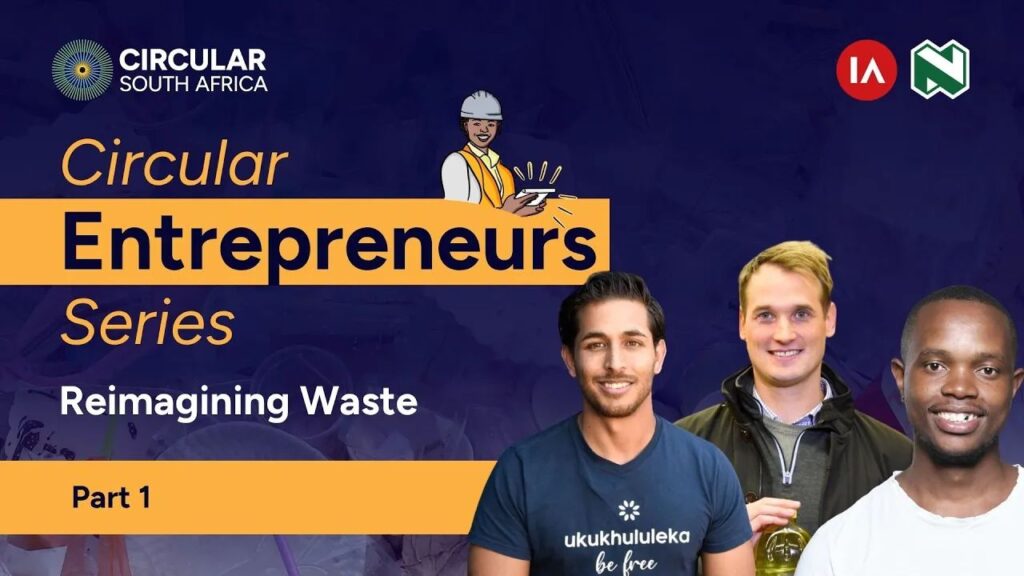
That was the thread running through the first Nedbank ReNEW Circular Entrepreneurs Series webinar, hosted in partnership with Circular South Africa and Impact Amplifier. The session brought together three entrepreneurs working at different points in the circular economy value chain. Each one showed, in a very practical way, how waste can become a source of income, resilience and measurable environmental benefit.
Core takeaway: the circular economy becomes most powerful when it links environmental problem-solving with jobs, affordability and inclusion.
Circularity is bigger than recycling
Circular South Africa opened the session by making an important distinction. A circular economy is not simply a better version of recycling. It is a systems approach: designing waste out from the start, keeping materials in use at their highest value for as long as possible, and helping natural systems recover rather than degrade.
In South Africa, there is another layer that cannot be ignored. Circularity also has to be inclusive. The benefits need to reach workers, small businesses and communities – not only companies already positioned to take advantage of the transition.
The three businesses profiled in the webinar brought this idea to life. They work with different waste streams and business models, but they share a common belief: environmental problems can be turned into economic opportunities when the right systems are built around them.
Why ReNEW exists
Speaking on behalf of Nedbank, Gabriella Makonese reflected on the bigger purpose behind ReNEW. The programme was created to respond to two challenges that are often treated separately, but are deeply connected: youth unemployment and environmental sustainability.
Rather than positioning ReNEW as just another accelerator, she described it as a platform for environmental, economic and generational transformation. That framing matters. The goal is not only to help circular economy ventures grow. It is to support businesses that can create livelihoods while changing how materials, products and resources move through the economy.
Impact Amplifier’s Max Pichulik echoed this point, noting that many of the solutions needed for the 21st century will come from entrepreneurs who are able to redesign systems around food, waste, water, energy and resource use. ReNEW is focused on early-stage circular economy ventures with the potential to create jobs and improve environmental outcomes at the same time.
Nearly 100 ventures have already taken part in the programme’s acceleration activities, with capital deployment now beginning for a select group of high-potential businesses.
Liquid Gold Africa: turning organic waste into useful products
One of the featured entrepreneurs was Orion Herman, founder of Liquid Gold Africa. Operating from KwaZulu-Natal, the company is taking on one of South Africa’s largest waste challenges: organic material going to landfill.
Organic waste makes up about 27% of the material reaching landfill. Much of it still contains nutrients and value, but when it is buried, it contributes to methane emissions and represents a missed economic opportunity.
Liquid Gold Africa’s model uses biological systems to capture that value before it is lost. At the centre of the business is an insect-based waste management platform, using black soldier fly larvae to convert food waste into alternative proteins for animal feed, fertilisers and other biological inputs.
The company is also working on sanitation innovations that recover nutrients from human waste streams and convert them into agricultural inputs. It is a strong example of circular thinking in practice: waste is not treated as the end of the line, but as the start of a new value chain.
Urban Surfer: putting waste reclaimers at the centre
For Sifiso Gumbi, founder of Urban Surfer, any serious conversation about circularity has to start with the people already doing the work.
South Africa’s informal reclaimers recover the majority of recyclable materials that eventually enter formal recycling systems. Yet they are still too often invisible in circular economy discussions. Gumbi’s own journey began as an informal reclaimer, and Urban Surfer was built to improve the income, safety and recognition of waste pickers.
The organisation supports reclaimers with equipment, protective clothing, training, recycling hubs and access to better markets. It also uses data systems to track material volumes, income growth and environmental impact, helping to make the work more visible and more valued.
Through these interventions, reclaimers who previously earned modest incomes have been able to increase their earning potential and build greater legitimacy within the recycling ecosystem.
Urban Surfer’s work underlines one of the most important lessons from the webinar: closing material loops is not enough. A circular economy also needs to close social and economic gaps.
Skubu: reducing the poverty tax through refill retail
Eben de Jongh, founder of Sonke Retail and Skubu, brought a different perspective to the discussion: affordability.
His business is tackling what he describes as the ‘poverty tax’. Lower-income consumers often pay more per unit for essential household products because they can only afford to buy small pack sizes. Those small formats also create far more packaging waste.
Skubu’s refill stations are designed to solve both problems at once. Customers can bring their own containers and buy household products in smaller quantities, while still accessing the pricing advantages of bulk supply. By removing unnecessary packaging and shortening parts of the supply chain, the model reduces costs for consumers and cuts waste at the same time.
The company has already deployed more than 80 refill stations across multiple countries and is continuing to expand through formats that make refill retail easier to access.
Collaboration will shape the next phase
Although the businesses operate in very different parts of the circular economy, a clear theme ran through the webinar: none of this work scales in isolation.
Several speakers pointed to the fragmentation that still exists across South Africa’s circular economy ecosystem. Entrepreneurs are often solving connected problems, but doing so separately – across different materials, technologies, regions and customer groups.
ReNEW is therefore not only supporting individual ventures. It is also encouraging collaboration between cohort members and exploring joint pilots where businesses can work together across the value chain.
That may be one of the most important roles the programme can play. Individual innovations matter, but systemic change requires stronger links between entrepreneurs, investors, corporates, government and communities.
Looking ahead
The first Reimagining Waste webinar showed that South Africa’s circular economy is not an abstract future idea. It is already being built through practical, scalable businesses.
From converting food waste into protein and fertiliser, to improving the livelihoods of waste reclaimers, to cutting packaging waste while lowering the cost of household essentials, the entrepreneurs featured in the session showed that environmental sustainability and economic opportunity can reinforce each other.
The question is no longer whether these solutions exist. It is how quickly they can be supported, connected and scaled.
As the Nedbank ReNEW programme continues to deploy capital and strengthen the ecosystem around circular economy ventures, the stories shared in this session point to a different way of thinking about waste. It may not be a burden to manage, but one of South Africa’s most important untapped opportunities.
The next webinar in the Reimagining Waste series will continue exploring the entrepreneurs and innovations reshaping South Africa’s circular economy.